Editing vs Retouching: The Difference You Don’t See - and the Quality You Feel
In photography, the words editing and retouching are often used interchangeably. They shouldn’t be. While both are part of post-production, they represent two very different levels of craft, time investment, and expertise.
If you care about longevity, print quality, and images that feel as refined years from now as they do on your screen today, the difference matters more than you might think.
Editing: The Foundation Every Professional Provides
Editing is the essential first stage of post-production. Every professional photographer edits their images, and rightly so. Editing establishes the overall look and feel of a gallery and ensures visual consistency from one image to the next.
Editing typically involves global adjustments such as:
Exposure and contrast correction
White balance and colour accuracy
Highlight and shadow refinement
Cohesive colour grading
Cropping and straightening
Removing some bits in the background
Removing a spot or scar if needed
This work is usually carried out in Lightroom and is focused on tone, atmosphere, and storytelling. Editing sets the mood. It defines whether an image feels soft, cinematic, editorial, or romantic.
Editing is skilled work, but it is only the beginning. So what’s that whole retouching that Dom can’t stop talking about?
Retouching: Where Experience Becomes Visible
Retouching is a separate discipline entirely.
Unlike editing, retouching involves precise, local adjustments made to specific areas of an image. This is where photographs are refined at pixel level, using advanced tools in Photoshop. This is what I refer to when I say that I ‘move pixels around’ - because this is exactly what it is! Retouching cannot be automated, rushed, or applied uniformly across a gallery. Each image is approached individually, with intent. Each image can take up to 60 mins to retouch! But the effects are absolutely breathtaking.
Honestly, I will try to keep this blog post readable… but I am so passionate about retouching that it might be difficult to not write a whole dissertation about it!
Professional retouching may include:
Skin refinement that preserves natural texture, using a specific set of tools, altogether called ‘frequency separation’. Absolute magic!
Removing temporary blemishes, redness, or shine
Cleaning flyaway hairs and distractions
Completely changing the background (have you seen my photo from ‘About’ page? Let’s just say it wasn’t taken in a studio, and there might have been my bed and a couple fof plants in the background…)
Dodge & Burn (I love!) - which helps brighten certain areas and darken others. It’s similar to masking in Lightroom but it’s much more fun to use!
Refining fabric folds and uneven creases
Group photo but your aunt (by the way, why is it always the poor aunt?) yawning in the background? We will copy paste her face from another one!
Your groom closed his eyes during a key moment? I’ll copy paste his eyes from another pic… If you know you know…
Correcting makeup mishaps (or just making it a bit more visible - flash light can eat up a bit of the makeup)
Removing background clutter
Subtle compositing and problem-solving
copy pasting your dog into a group photo if they couldn’t make it to your wedding
Good retouching should never be obvious. Its purpose is not to alter how you look, but to remove anything that pulls focus away from the moment itself.
This level of refinement is standard in fashion and editorial photography - and far less common in weddings. But all my packages include 10 retouched images of your choice.
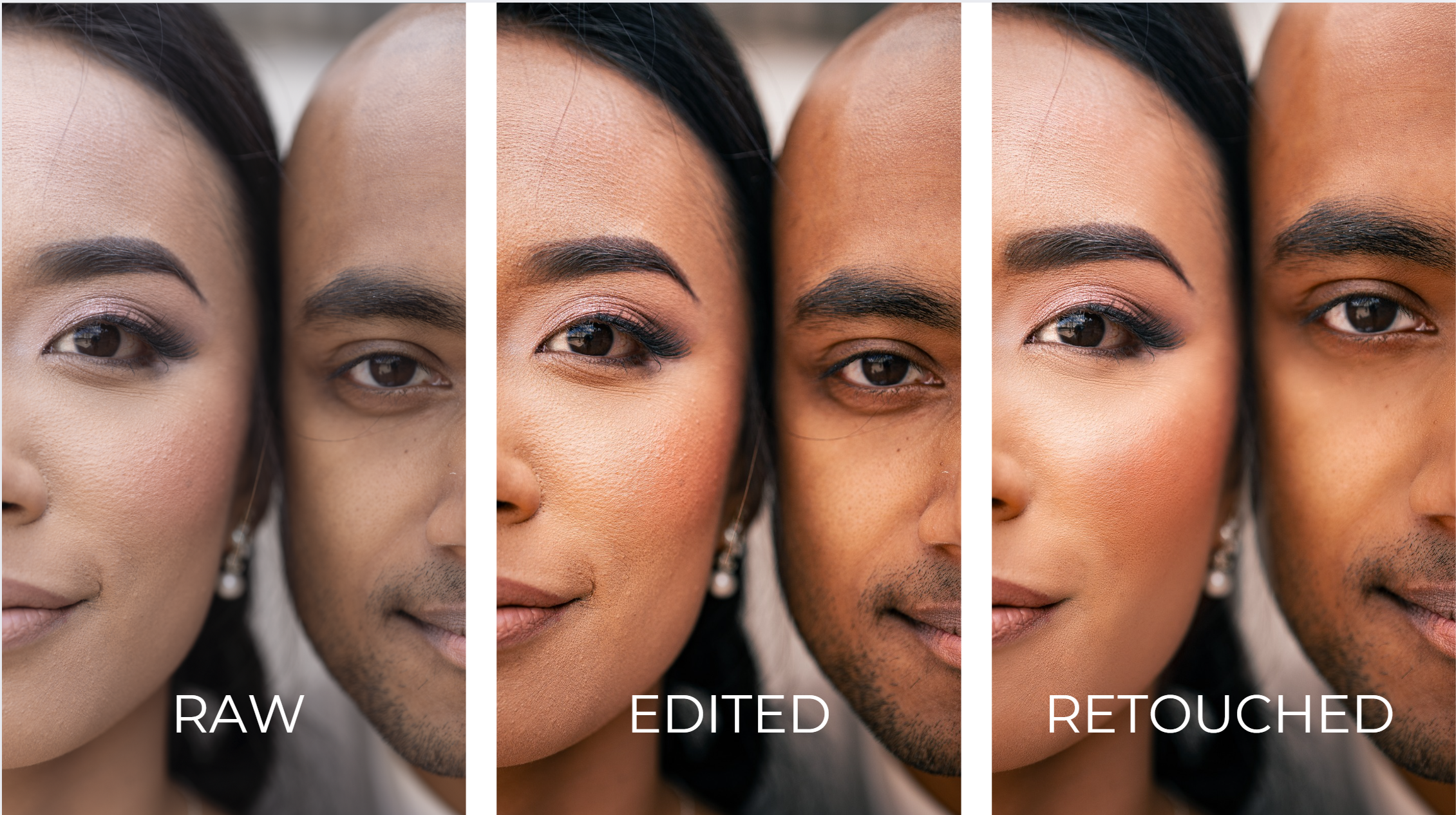
Here’s an example of what magic we can do (perhaps you’ve seen this image in one of my galleries?)
Can we see the difference? Probably you now can tell why I love Photoshop so much!
Why Retouching Is Rare in Wedding Photography
Retouching is rare in wedding photography for two reasons: time and expertise.
Proper retouching takes time - often 20 to 60 minutes per image, depending on complexity. It also requires specialist knowledge of light, skin, colour theory, and non-destructive workflows. Many photographers simply don’t offer it because they haven’t been trained in it.
I began my career in a studio environment, working alongside leading fashion photographers and completing formal training in studio photography, Lightroom, and advanced Photoshop retouching. In that world, retouching isn’t an optional extra - it’s an expected standard.
That experience fundamentally shapes how I approach wedding photography. That’s also the reason why I don’t take on as many weddings in a year as your ‘standard’ wedding photographer would. I prefer to spend more time on each gallery. For me it’s all about quality, rather than quantity.
Why All My Packages Include Retouched Images
Every one of my wedding packages includes 10 fully retouched images.
These are not randomly selected or lightly polished. They are carefully chosen, collaboratively if desired, and refined individually in Photoshop. These images are designed to be:
Print-ready
Exhibition-quality
Suitable for albums, wall art, and heirloom prints
Vogue-ready (you never know!)
They are the images you frame. The ones you return to years later. The photographs that deserve the highest level of attention.
Of course, your full gallery is beautifully edited for consistency and storytelling. But these retouched images are where my studio expertise becomes most visible - and where your photographs gain a timeless, editorial finish.
Editing Enhances. Retouching Refines.
Editing enhances what already exists.
Retouching refines what truly matters.
Anyone can apply a preset.
Not everyone can retouch with restraint, intention, and respect for reality.
Retouching is not about perfection. It’s about clarity. It’s about ensuring nothing distracts from the emotion, the connection, and the quiet moments that often mean the most.
Some call it magic.
I call it experience.